Binge Runs

Thankfully, the semester is over, which means that I have some more time on my hands to run/recover/sleep/eat/drink beer. Now that my foot is feeling (almost) normal again, I figured that since I have no immediate running goals, just the long-term desire to run faster, farther, and harder in some trail races next year, a few really long runs should be in the forecast. Having the lack of running-related pressure allows me the chance to basically run what, where, and however far I please, at least for the next several weeks, and the Binge Run seems to be the answer.

Now, there are a lot of runners out there, and I believe I’m in the minority when I tell people that I really enjoy running long, this is not to say that I don’t end my runs bonking, sore, stiff, dehydrated, and that bonking, being stiff, sore, and dehydrated doesn’t feel bad. It does. In fact, it feels really bad, and not to imply that I’m a masochist, if I were, I highly doubt that unnecessarily long runs would be my preferred method of discomfort and self-destruction (I think I’d choose the Stay-Puft Marshmallow man…). The reality of it, is when I find myself running for long time frames, it teaches me a lot, and allows me to fully decompress. It also helps me to jump-start my fitness, or at the very least stay relatively on-track.

Now the binge-run is a special case, typically it’s an obnoxiously long run (3+ hours?) preferably without any specific purpose. This allows me to not worry about pace, run where I want, and throw in the towel whenever I feel like, allowing me to only concentrate on running, and enjoying the trip. There are a few disclaimers to the binge run, in case any of you are thinking of attempting it.

It DOES require some planning, if you run trails like I do, run in a system you’re familiar with, or at the very least bring a MAP (best plan, do both!!)

Food and Water are imperative! I always bring way more Gu (or whatever I’m eating this week) than I think I need… and carry at least 1, sometimes 2 handhelds.

Let someone know what you’re doing! This sounds like a no-brainer, but the more comfortable you are, the less likely you are to let someone else know whats going on. There is some risk involved, especially on trails, the last thing you need is to roll an ankle 10 miles from your car, and have no one know you’re missing…. not exactly 127 hours, but in the case you get hurt/lost, it’s nice to know someone will eventually start looking.

Lastly, even though this usually goes against my M.O. this run, I was talked into bringing a cell-phone with me. They’re useful in the OH SHIT situations, and most cell-phones have GPS so you can either be located, or map your way out of the woods… Maybe this is worth the weight… although my inner minimalist is still anti-technology.
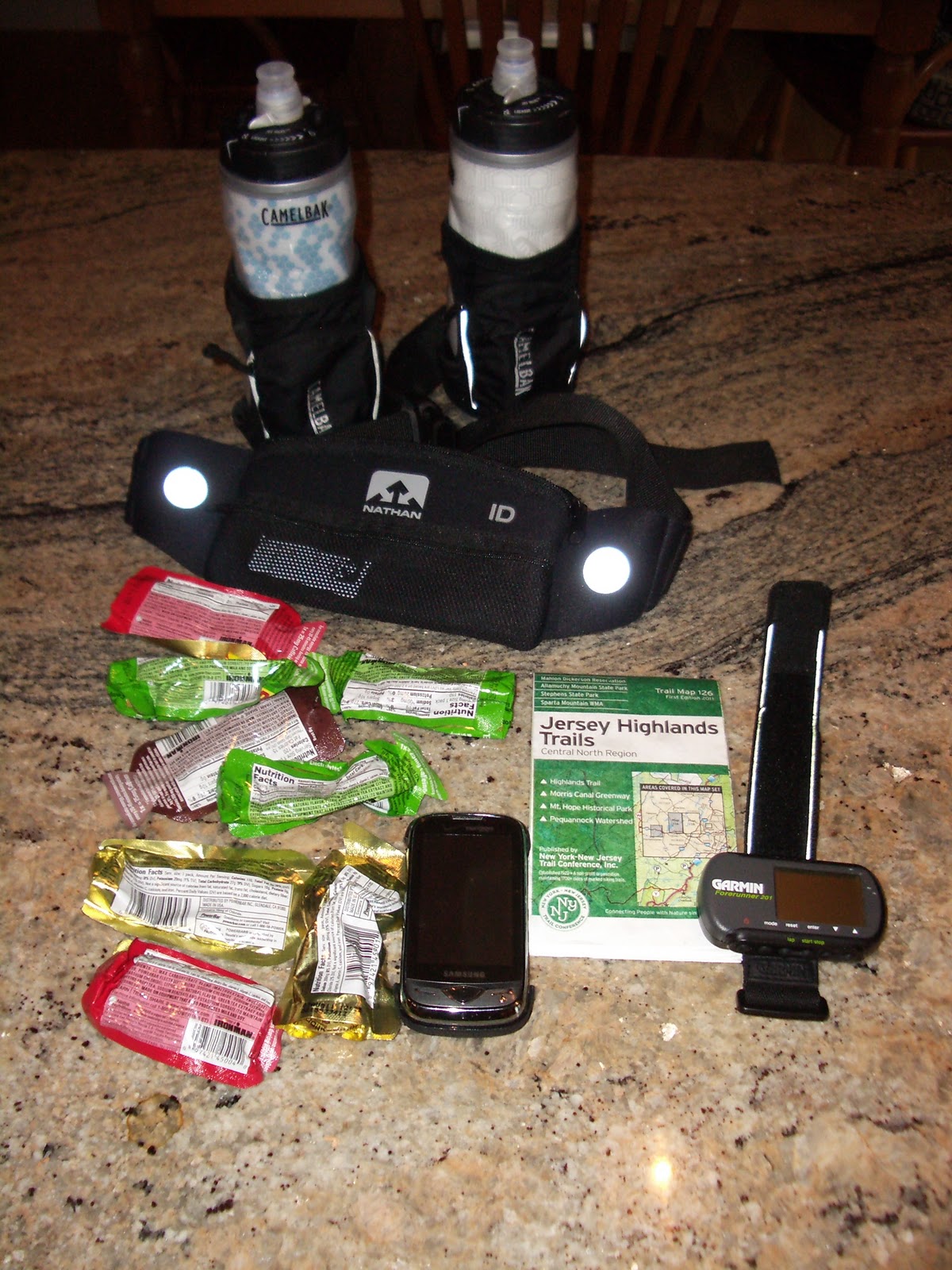
Phone, Food, Water, Garmin, Map


Trailhead

TURN LEFT!


Mid-Run Snack

Saw this 2.5 hours in… I couldn’t help but yell it out loud

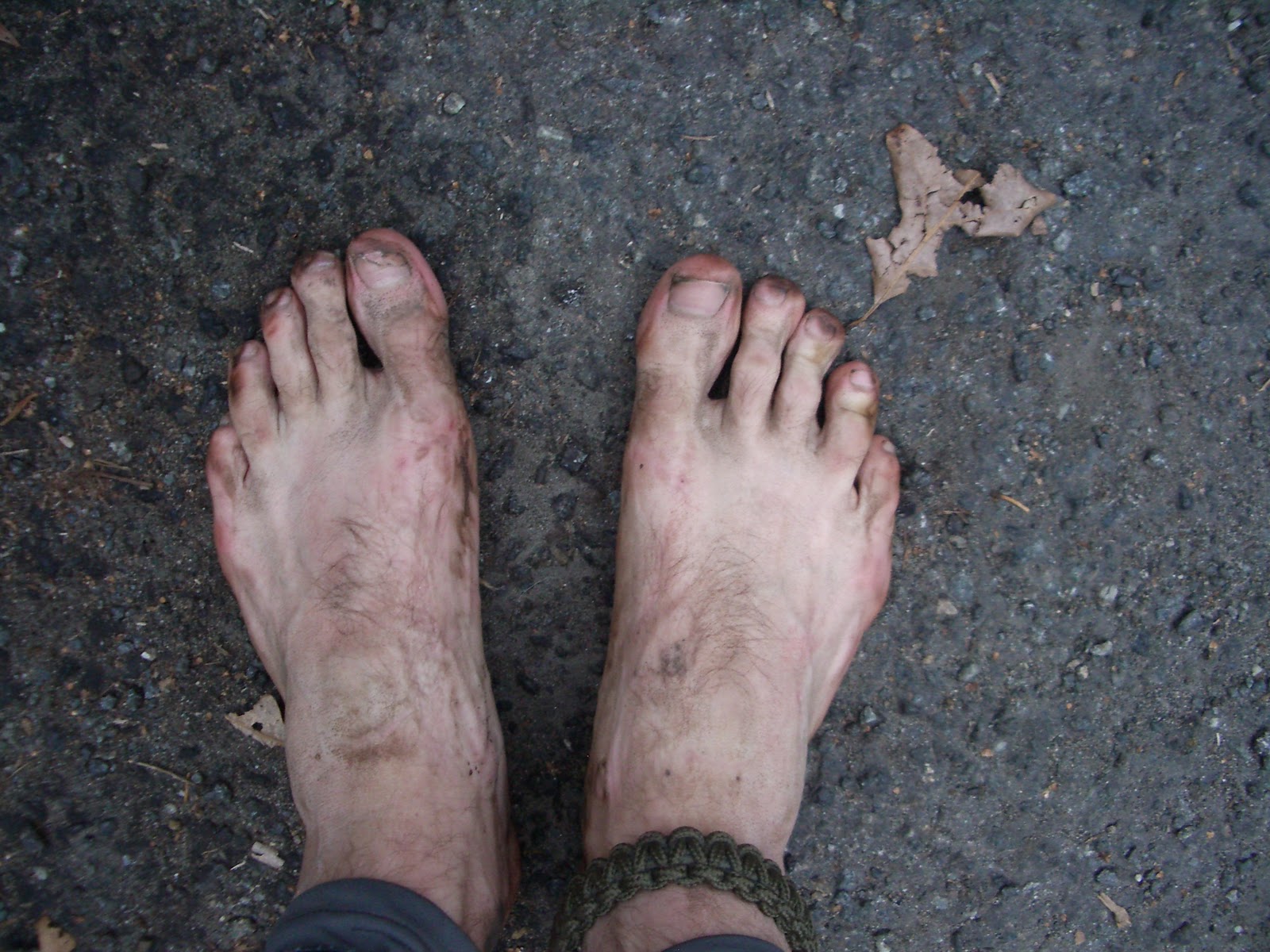
Mountain running may be hazardous to your pedicure


Post Marathon Recovery

Embarrassingly, my mileage has taken a rather awful turn since I ran the Atlantic City Marathon nearly 3 weeks ago. I recall running a 50k in August, and suffering a similar recover-oriented fate, where a combination of latent soreness, glycogen depletion, and varying certainty regarding my fitness/performance caused me to lag for a few weeks until I felt fully recovered. This run was no different, I attempted a 10 miler about 6 days afterwards, and had the worst bonk I can recall, although my overall time was reasonable. I’ve taken 7 of the past 21 days off, having broken my “streak” the tapering week before the race. Some of these days were schedule oriented (as in, no time to run) and some were a combination of fatigue/laziness, but overall, I’ve got to attribute it to lack of motivation/laziness, which isn’t always a bad thing, and since I have time to let my body rest some, It’s probably advantageous in the long term to do so. Here, however, are the stats:
Miles Oct 17-Nov 5: 51.3
Hourage: 8hrs 9min
This week I’m planning to get back on the horse proper to start preparing for a 50k in January, and a possible 50 miler in Feb, so High mileage, and lots of trails in the near future!

What makes a good shoe?

Today I received two pairs of running shoes from the Merrell company. As some of you may know, Merrell tends to do things a little bit differently, and strongly encourages the average Joe hiker/runner to test their beta models, and provide them with honest feedback, which I think is awesome, this system helped produce the Trail Glove (review coming soon) and checking out the shoes I got today, I can see that they’ve really got their heads in the right place as far as providing sustainable running shoes for (barefoot) form-oriented mountain runners.
I mentioned in a previous post that my rule as far as running shoes and reviewing them is concerned, is that I require ~100 miles on a pair of shoes before I think I can give an honest assessment of their value, and I plan on sticking to this, it helps that I (when not tapering) run relatively high mileage, so testing a pair of shoes rarely takes more than 2 weeks in my rotation, with perhaps a few extra days to re-compare them to favorites in my pile.
Now for the nitty gritty, there are certain things that I require in order to consider a shoe for racing/every day running usage.
1. MINIMAL Heel-Toe drop, Yes, minimal, a zero drop is preferable, but to be honest if it’s only a few millimeters, it doesn’t effect my gait, and thus becomes a non-issue (greater than 4 mm seems to get annoying, and often will be ghetto zero-dropped by me, over a beer or 3, with a bread knife)
2.Reasonable amount of protection. Depending on the ruggedness of a trail, (or road) the amount of protection necessary can vary (imho). Jason Robillard talks about the same conundrum here. Basically I want enough protection that my feet don’t hurt after a long run/race, but not so much that I can’t feel the ground beneath me, and end up making stupid mistakes resulting in ankle twists, falls, etc etc etc. This is a fine line to walk, and every runner/running shoe is different.
3. Water Drainage. A trail shoe especially MUST drain water well. I cannot tell you how many times in a single run I end up with my foot submerged in water, this water must exist my shoe, and the shoe must dry quickly, this is not negotiable. I do not believe in gore-tex running shoes, I understand the principle, but in my experience, I often find myself in water above the top of the shoe, which results in a gore-tex shoe/boot being filled up with water, and turning into a bucket attached to my foot, not ideal.
4. Traction. A good shoe should track well. There is a fine line between good traction and durability, which is why I insist on 100 miles before i announce my review. Softer rubber holds onto rock better, but also wears much more quickly, the opposite is true of harder rubber. Lugging must be wide enough to shed mud easily, and not turn my trail runner into a mud-caked flat, but also close enough to hold well in less than ideal terrain. Vibram typically makes a good sole… they are not the only reasonable sole out there though, and often I am surprised by what a sole looks like, and how well/not well it performs.
5. Lightweight. The heavier the shoe, the heavier the shoe, you figure it out.
6. Breathable upper. Also self-explanatory. The upper should also keep the foot securely in the shoe,and not blow out too easily (100 miles!)
7. Flexible heel. Allows for natural foot motion
8. Wide toe box. Allows toes to splay, keeps foot motion natural, helps body absorb shock better, leading to less injuries etc etc etc.

That’s pretty much it, I’ve got some reviews queued up, as many of my shoes are beyond the 100 mile mark, as well as some training updates to post soon.

In Favor of Short-Shorts

Now that summer is over, and it’s becoming more necessary to start wearing clothes, I thought I’d try my best to justify my summer attire, or lack thereof. Enter the split shorts. A lot of people find it strange that I would prefer to wear the shortest shorts available to runners, so allow me to explain it.
1. It’s hot outside, so why would I wear more than I need to, more clothes = more sweat, more sweat = more water to carry = slower runs…. you do the math.
2. Freedom of movement. The way that split shorts are cut allows the most freedom of movement I’ve experienced.
3. Better support. Even though longer shorts always come with a bloomer, or some similar support system, the support in split shorts in my experience, is always better. This may be because of the increased potential for a wardrobe malfunction, but regardless, it’s nice to have.
4. It makes a statement. As a runner, I think I need to embrace the good, the bad, and the ugly of being a runner, this includes embracing the style, and the aesthetic. Track athletes, marathoners, and a handful of ultra-runners embrace the short-short, and it’s one of the ways I like to embrace the aesthetic of being a runner.
Plus, these guys seem to dig them:

Scott Jurek

Killian Jornet

Anton Krupicka

Jesse Scott

Advantages

Many of my friends (okay, namely the Highlands Hashers) ask me how my running effects my “professional” life. I’ve always found this to be a difficult question, short of giving the usual stock answers: lowers stress, keeps me fit, etc etc. Now these are NOT the reasons I run, the reasons I run will likely be documented in a following post, but I can assure you that fitness/stress are not what gets me out of bed at 6am to hit the trails…. This past week however, with the start of the school year, comes the usual ring of academic-related auditions, mostly for seating/ensemble placement within the department. Anyone who races has an idea of the stress level associated with auditions, however, the engagement of the fight/flight mechanism is (in my experience) advantageous for a footrace. Unfortunately, as a clarinetist, the fight/flight mechanism is extremely disadvantageous for a performance, increased heart-rate, adrenaline, sweat, none of this bodes well for musical performance.

How has high mileage helped this? Well, as a result of my weekly mileage, and the ensuing fitness level, my resting heart rate is low, I refuse to check it, since I don’t really dig the whole numbers thing, especially regarding heart rate, VO2 max etc etc, but trust me, its low. This means that when my flight mechanism does kick in during the audition setting, the ensuing heart-rate increase begins from a much lower level, resulting in a stressed heart-rate being substantially lower than I can recall ever having in that situation! Not to mention the additional confidence from knowing what you’re really made of. Having run a self-supported ultra-marathon, hiked solo through the Whites and Mahoosucs, grown a massive beard, and lost my fair share of auditions where more than pride is on the line, I’m able to approach the audition in a much calmer fashion than I would have as recently as a year ago, nevermind 6 years ago.

The (relative) success of last weeks 2 auditions, and how I think my running has affected my energy levels throughout these has motivated me to run, and practice more. I’m now more thoroughly looking forward to upcoming races (50k’s 50 milers and a ?hundred?) recitals, and whatever else life throws my way!